
Barcode label basics
A barcode is a measurement problem as much as a printing problem. Contrast, quiet zones, and module size have to survive the lab.
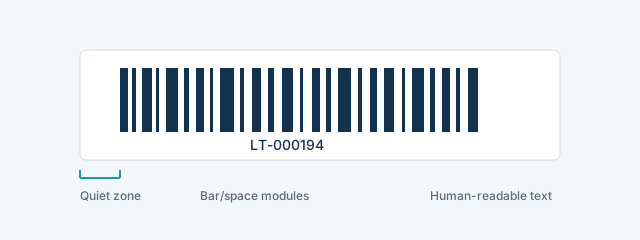
A barcode is a machine-readable spelling of an identifier. Linear symbols such as Code 128 encode data in bar and space widths. Two-dimensional symbols such as QR Code or Data Matrix encode data in a matrix. GS1 maintains widely used data structures. ISO/IEC 15416 describes print-quality grading for linear barcodes. ISO/IEC 18004 specifies QR Code. None of those documents pick a laboratory label film for you, but they explain why a pretty label can still be unscannable.
Contrast and background
Scanners look for dark modules on a light background, or the reverse in some special cases. Frost, condensation, and solvent haze reduce contrast. A silver or clear film can look elegant and still fail a verifier. If the tube is scanned in a rack, test in the rack, not on a white desk.
Quiet zones
Linear symbols need clear margins on both sides. Overlap wrap, a cap skirt, a glove, or another label will look like extra bars. 2D symbols need a quiet zone around the matrix. Crowding a code to the edge of a cryovial is a common self-inflicted fail. See barcode readability in cold storage.
X-dimension and printer capability
The narrowest bar (x-dimension) cannot be smaller than the printer can produce cleanly. A 203 dpi thermal printer has a native dot size; asking it for bars narrower than that native grid creates quality problems. Darker print is not always better: overburned thermal-transfer bars spread and close spaces.
Human-readable fallback
Print the identifier under or beside the code in a font large enough for the working distance. Frosted vials and failed scanners should not force anyone to guess. Patient-safety oriented programs such as The Joint Commission’s National Patient Safety Goals and CAP laboratory accreditation emphasize correct identification; a code that cannot be recovered by eye is a fragile control.
Verification versus “it scanned once”
A single handheld scan on a new label is not a quality grade. ISO/IEC 15416-style verification uses defined lighting and measurements. Laboratories that depend on automation should treat verifier reports as process control, especially after ribbon, darkness, or media changes. NIST maintains broader measurement science resources if you need metrology context; barcode quality still sits in the ISO/IEC and GS1 documents.
| Symptom | Typical cause |
|---|---|
| No read on first try | Low contrast, frost, or quiet-zone clip |
| Reads only at one angle | Wrap distortion or specular glare on film |
| Wrong data | Truncated symbol or human-readable mismatch |
| Works at bench, fails in freezer | Condensate, ice crystals, fogged imagers |
Internal numbers versus GS1 identifiers
Research freezers often encode an internal accession. Shared biobanks and supply chains may require GS1 element strings. Mixing the two without a quiet, documented rule produces scanners that “work” only in one department. GS1 General Specifications explain how application identifiers are structured; they do not require every academic freezer to become a retail supply chain. Choose a scheme, print it consistently, and keep the human-readable text in the same scheme.
Check digits catch some keying errors. They do not catch a frost-damaged quiet zone. Process control still needs print quality and environmental margin. If you add a check digit, train people not to type it as part of a spoken ID unless the SOP says to.
Glare, curve, and film finish
Glossy films can specularly reflect imager illumination so the code blooms. Matte topcoats often scan more reliably on curves, at the cost of a different ribbon match. Test the finish you will buy, on the diameter you will use, with the imager you will carry into the cold room.
Questions this page answers
Is a QR Code always better than Code 128 on a tube?
2D symbols fit small areas. Linear symbols can be fine on larger bottles. Choose by space, scanner type, and the data you must encode.
Do I need GS1 identifiers in a research freezer?
Only if your sharing or supply chain requires them. Internal accession numbers are common in research; they still need unique, durable encoding.
Can I put two barcodes on one label?
Yes if each has quiet zones and operators know which to scan. Overlapping or nested codes cause double reads.
Why did quality drop after a ribbon change?
Ribbon chemistry and darkness interact with the face stock. Re-verify after supply changes.
Sources you can check
- ISO/IEC 15416, linear barcode print quality
- GS1 barcode standards
- GS1 General Specifications
- ISO/IEC 18004, QR Code
- The Joint Commission, National Patient Safety Goals
- College of American Pathologists
- National Institute of Standards and Technology
External sites are cited for verification. Labeltaglab is not affiliated with those organizations. See the external links disclosure.