
Freezer labels
Frost, glove handling, and thaw water fail freezer labels more often than the setpoint alone.
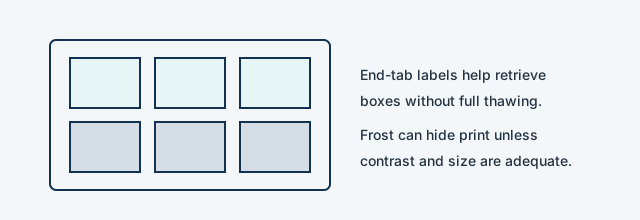
Laboratory freezers cluster around two setpoints people actually say out loud: about −20 °C and about −80 °C. Both form frost. Both are opened with bulky gloves. Both reward labels that were applied on dry containers before the first freeze. The difference is how little the adhesive can flow at ultra-low temperature and how opaque the frost can become on box ends.
−20 °C freezers
These units store many reagents and some clinical or research materials. Door seals drip. Boxes rattle. Paper labels absorb moisture and can peel as fibers weaken. Film labels still fail if the wrap is short or if tubes were labeled while wet from an ice bucket. Alcohol wipes used at the bench before freezing add a chemical demand the freezer itself did not create.
−80 °C ultra-low freezers
Racks are dense. Retrieval time is limited because every open-door interval warms the cabinet. Labels that lift become snag points. Print that lacks contrast becomes invisible behind frost. If your inventory depends on scanning box ends in place, design the end-tab for the scanner distance you actually use, not for a photograph on a desk.
Boxes versus vials
A box end is nearly flat. Adhesion is easier than on a cryovial, but abrasion against adjacent boxes is worse. Use a face stock that does not scuff to illegibility. Vials inside the box still need their own IDs; lid labels get swapped. See labels by container.
Freeze–thaw and condensate
Pulling a box to the bench melts frost into a water film. That film can migrate under edges and across thermal-transfer or inkjet images that were never meant to be rinsed. Dry the box before returning it if your SOP allows, and choose print methods that survive a wipe. The article condensation and label readability walks through this failure in more detail.
Inventory practice
Repository guidance such as ISBER Best Practices emphasizes location control and specimen tracking. A freezer map in a spreadsheet cannot rescue a box whose end-tab fell into the rack. Unique IDs on both box and vial, with the vial as the durable identity, reduce mix-ups when lids are borrowed.
Frost-free cabinets and manual-defrost chests
Frost-free freezers move air and run defrost heaters. Labels see more temperature cycling and more blown frost crystals than they do in a manual-defrost chest that is opened rarely. Neither design is “easier” in the abstract: circulating frost abrades box ends; thick frost in a chest hides tabs. Describe the cabinet type in a trial, not only the setpoint.
Color-coded dots are popular and fragile. Color that is the only identifier fails when lighting is poor or when two groups chose similar hues. Use color as a hint, not as the unique ID. Print the accession on the box end and on the vial. When a lid is borrowed, the vial should still speak.
Maps are not marks
A spreadsheet freezer map is a finding aid. It does not attach to the plastic. If a box rotates 180° on a shelf, the map is wrong and the end-tab is what you have left. Design the tab for that moment: large type, high contrast, and a code that still has quiet zones after frost.
| Check | Why it matters |
|---|---|
| Apply on dry, preferably ambient containers | Frost is a release layer |
| Full-finger pressure on the wrap or tab | Edges start peels |
| Contrast and size through frost | White-on-white films disappear |
| Box end plus vial ID | Lids move; contents should not lose identity |
| Print that survives a thaw wipe | Meltwater is a solvent for some inks |
Questions this page answers
Is a cryogenic label required for −80 °C?
Not automatically. Some constructions are described for ultra-low freezers without LN2. Use the stated range and your tests; do not assume LN2 and −80 °C are the same.
Why do box labels scuff?
Racks slide. Soft coatings and heavy frost crystals act like sandpaper. A tougher topcoat or laminate can help if the manufacturer offers one.
Can I put a paper laser label in a −20 °C freezer?
It may last for dry, short storage. Moisture and freeze–thaw often cockle paper and lift edges. Film is the more conservative default for repeated access.
Should barcodes run horizontally on box ends?
Orient them to the scanner you own. Quiet zones must stay clear of box corners and adjacent labels.
Sources you can check
- ISBER Best Practices for Repositories
- ISO 20387, Biotechnology — Biobanking
- ASTM D3330/D3330M, peel adhesion of pressure-sensitive tape
- CDC/NIH, Biosafety in Microbiological and Biomedical Laboratories, 6th ed.
External sites are cited for verification. Labeltaglab is not affiliated with those organizations. See the external links disclosure.