
Laboratory label printing methods
If the image cannot survive the process, the best adhesive in the world still leaves you with a blank tube.
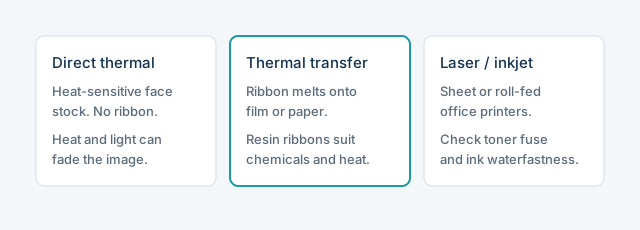
Laboratories print identifiers with direct-thermal printers, thermal-transfer printers, laser printers, inkjet printers, and dedicated slide or cassette printers. Each method creates the image with a different chemistry. Matching that chemistry to solvents, steam, and cold storage is as important as matching the adhesive.
Direct thermal
The printhead heats a coating on the face stock. No ribbon is used. The method is simple and common for short-lived shipping labels. The same heat sensitivity that makes printing easy makes the image vulnerable to hot bags, sunlight, and autoclave chambers. Direct thermal is usually a poor default for long-term biospecimen storage. Details: thermal transfer versus direct thermal.
Thermal transfer
A ribbon (wax, wax-resin, or resin) melts onto the face stock. Resin ribbons on polyester films are widely used when chemicals or abrasion are expected. The ribbon and the film are a pair: a resin ribbon on the wrong topcoat can flake. Printer darkness, speed, and head temperature are process parameters; changing them changes barcode grade.
Laser (electrophotographic) printing
Toner is fused onto sheet labels. Fusion quality depends on the printer’s temperature profile and the label’s heat tolerance. Some adhesives ooze in laser printers and damage the machine—use media the printer maker allows. Fused toner can be durable against dry handling and some water, but solvent resistance varies.
Inkjet
Liquid ink sits on or in the coating. Waterfastness and solvent fastness depend on ink and media. Dye inks often run; some pigment systems do better. Inkjet is attractive for color hazard marks, but it must be tested against the wipe you actually use. OSHA hazard communication may require durable workplace labeling for chemicals; an inkjet that runs in ethanol is not durable in that sense.
On-demand versus batch
Printing at the moment of use from a LIMS reduces leftover preprinted stock and mismatch. Batch printing is fine for stable accession series. Either way, keep a log of media lot, ribbon lot, and darkness so a scan failure can be traced. UL 969 is an example of a marking-system durability standard used in industrial nameplates; laboratory labels are not automatically UL 969 certified because someone cites the number. If a vendor claims a standard, read the actual scope.
Resolution, darkness, and worn heads
Thermal printers are often 203, 300, or 600 dots per inch. A barcode x-dimension that is not a multiple of the native dot size will be approximated, and approximation shows up as poor grading. Darkness that is too high fills spaces; darkness that is too low thins bars. Clean and, when needed, replace printheads instead of endlessly raising darkness to chase a worn element.
Keep a small archive of known-good labels from each media lot. When a freezer aisle suddenly will not scan, compare a new label with the archive under the same imager. You will learn whether the process drifted (ribbon, darkness, speed) or the environment did (frost, lighting). That comparison is cheaper than replacing every roll in the building.
Office printers in a laboratory corridor
Sheet labels in laser printers must be designed for the fuser temperature. Adhesive that oozes coats rollers. Inkjet labels must dry before they are stacked or they offset onto the next sheet. Neither failure is a freezer problem; both will be blamed on “the labels” unless the print step is written down.
Questions this page answers
Can I run laboratory film labels through any office laser printer?
No. Heat, thickness, and adhesive ooze can damage printers. Use media rated for that engine.
Is a resin ribbon always required?
For many solvent and abrasion jobs it is the starting point. For dry, short-term paper labels, wax ribbons or laser toner may be enough.
Why are barcodes fuzzy?
Worn printheads, too much darkness, wrinkled media, or an x-dimension below the printer’s native dot size.
Do cassette printers follow the same rules?
They are specialized thermal devices with their own media. Apply the same idea: match image chemistry to solvent and heat, then test the instrument.
Sources you can check
- ISO/IEC 15416, linear barcode print quality
- GS1 barcode standards
- OSHA Hazard Communication Standard
- UL 969, marking and labeling systems
- ISO 17665:2024, moist heat sterilization
External sites are cited for verification. Labeltaglab is not affiliated with those organizations. See the external links disclosure.