
RFID label basics
An RFID inlay is a small radio. Water, metal, and missing fallback print are the usual laboratory surprises.
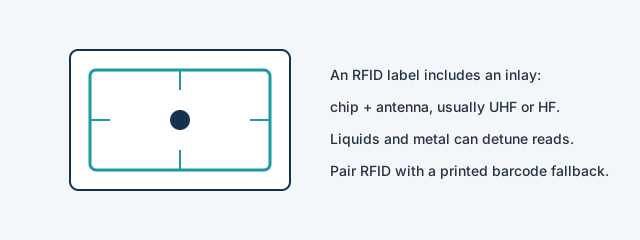
Radio-frequency identification (RFID) puts a chip and antenna—an inlay—inside a label or tag. A reader energizes the inlay and receives an identifier. High-frequency (HF) systems around 13.56 MHz include ISO/IEC 15693 vicinity cards. Ultra-high-frequency (UHF) item management often references ISO/IEC 18000-63. GS1 also publishes Electronic Product Code (EPC) guidance in its general specifications. Those documents describe air interfaces and data; they do not make a vial of water radio-transparent.
Why laboratories consider RFID
A line-of-sight barcode needs a person or a well-aimed imager. RFID can, in suitable setups, identify items in a box or on a shelf without rotating every tube. That promise collides with physics: liquid water and metal absorb or detune UHF fields. A box of aqueous samples is a difficult UHF environment. HF can be more forgiving at short range but is not magic either.
Inlay placement on small containers
The antenna needs area. On a 0.5 mL vial there may not be enough flat real estate. Some designs put the inlay on a flag or on the box rather than on every tube. Box-level RFID plus vial-level barcodes is a common hybrid: the radio finds the box, the barcode confirms the vial. Do not assume item-level RFID on every cryovial without a pilot.
Always keep a visual identifier
Batteries are not required for passive RFID, but readers, firmware, and software are. When a reader is down, a printed barcode and human-readable ID still work. Treat RFID as an overlay, not as the only mark. See barcode basics.
Environment
Extreme cold, autoclave steam, and solvents attack the laminate around the inlay as they attack any label. The chip also has a manufacturer temperature range that is independent of the adhesive range. If either is exceeded, the tag can die while the printed text remains. Specify both.
Privacy and data
This site does not collect data and does not operate RFID systems. If a laboratory encodes identifiable human information into a tag, that is a records and ethics problem governed by the institution, not by a label catalog. Prefer opaque accession numbers that map to a controlled database.
Dense boxes, metal racks, and collisions
UHF energy does not politely visit every inlay in a tightly packed, water-filled box. Some tags shadow others. Metal freezer racks detune antennas. Anti-collision protocols help when the physics still allow a response; they cannot create a signal that water has absorbed. Pilots should use filled tubes, real density, and the real rack alloy—not a single dry tag on a wooden table.
If a program needs both speed and certainty, pair box-level RFID with vial-level barcodes. The radio finds the neighborhood; the optical code confirms the item. That hybrid is less glamorous than “scan the whole drawer at once” and more honest about liquids.
Encoding and killing tags
Writing an ID to a chip is a process step with failure modes: unwritten tags, locked memory, and duplicate EPCs. Treat encoding like printing: verify a sample, and keep a printed overlay. Decommissioning tags when vials are discarded is an institutional records choice; this site does not operate such a system.
Questions this page answers
Can RFID replace barcodes in a freezer?
Only after a pilot in that freezer, with those liquids, at that density. Many programs keep barcodes as the fallback.
Why does a tag read on an empty tube but not when filled?
Water changes the antenna environment. Test filled containers.
Is HF or UHF better for vials?
It depends on read distance, density, and liquid content. UHF offers longer range in air; liquids and metal are harsh. HF is often used at short range. Measure both if you are choosing.
Do RFID labels need special printers?
Encoding usually needs a printer or writer that can program the chip as it prints the overlay. Not every office printer can do that.
Sources you can check
- ISO/IEC 18000-63, RFID for item management (UHF)
- ISO/IEC 15693, vicinity RFID (HF)
- GS1 General Specifications
- ISO/IEC 15416, linear barcode print quality
- National Institute of Standards and Technology
External sites are cited for verification. Labeltaglab is not affiliated with those organizations. See the external links disclosure.