
Cryogenic labels
Treat liquid-nitrogen service as thermal shock plus a tiny curved surface—not as a colder −80 °C freezer.
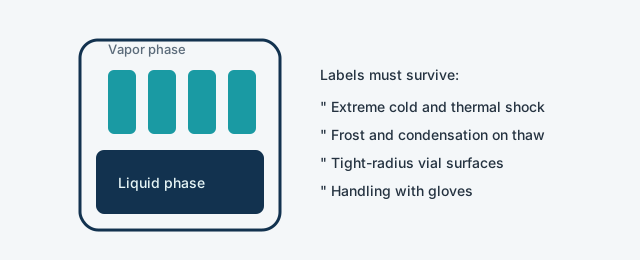
Cryogenic storage is not simply “a colder freezer.” Liquid nitrogen boils at about −196 °C at atmospheric pressure. Vapor-phase storage above the liquid is still far below ultra-low freezer setpoints. A vial can be plunged from a warm bench into that environment, then later thawed under running water or in a water bath. Labels see contraction, possible immersion, ice, and glove abrasion in one workflow.
What “cryogenic label” should mean in a specification
Ask whether the manufacturer describes vapor-phase storage, liquid-phase immersion, or both. Those are different exposures. Immersion can force liquid under a poorly wrapped edge. Vapor-phase storage still includes thermal shock and frost. If a data sheet only says “freezer” or lists −80 °C, it has not answered the LN2 question.
Labeltaglab does not invent service temperatures. Treat every numeric rating as a manufacturer claim to be verified on your vials, with your wrap, and with your thaw method.
Geometry on cryovials
Internal-thread and external-thread cryovials leave different wall heights. Writing patches, barcode panels molded into the tube, and skirted bases steal space. A wrap that worked on a 2.0 mL vial may overlap a 0.5 mL vial’s cap. Measure the printable height with the cap on. See tube and vial labels for wrap math.
Some laboratories use flag labels (a laminated tail) so a 2D code can be larger than the vial circumference allows. Flags catch on boxes and can tear if the film is brittle at low temperature. If you use flags, test box fit and glove handling, not only adhesion on a bench.
Application on cold or wet walls
Best practice is to label dry vials at ambient temperature before they go to LN2. When that is impossible, frost is the enemy. Wipe, use a manufacturer-stated cold-apply adhesive if you have one, and press the full wrap. A center tap leaves channels at the edges where nitrogen or later meltwater can enter.
Print that remains readable after frost
Resin thermal-transfer images on film are commonly chosen because they keep contrast after wiping. Direct-thermal paper is a weak default: heat-sensitive coatings and paper fibers do not match this environment. Human-readable text should stay large enough to read through a frost haze. Barcode quiet zones need extra margin because ice crystals act like damage. See barcode readability in cold storage.
Identity in repository practice
ISBER Best Practices and ISO 20387 discuss specimen tracking and storage quality. They assume the physical identifier remains associated with the material. CDC/NIH BMBL and the WHO laboratory biosafety manual discuss safe handling of biological materials in cold storage contexts without specifying a sticker brand. Use those documents for operational context; use manufacturer data and your own trials for the label construction.
LabTAG and other specialist manufacturers publish cryogenic application notes. Read them as vendor information. Labeltaglab is not affiliated with those companies and does not reproduce their artwork or claims as its own tests.
Questions this page answers
Does vapor-phase storage need an immersion-rated label?
Vapor-phase is still cryogenic, but it is not the same as sitting in liquid. Use the exposure the manufacturer actually lists, then test your own dewar practice.
Why do labels crack on LN2 vials?
Some films embrittle when cold and then flex during handling. Cracking is a material and thickness issue, not only an adhesive issue.
Can I relabel a vial that already lived in LN2?
Only with a procedure that dries the wall and uses a construction meant for that surface. Old adhesive residue can block a new label.
Are handwritten cryovial marks enough?
Markers can work for short procedures if the ink is compatible, but they smudge, fade, and do not scan. Unique printed IDs are easier to inventory.
Sources you can check
- ISBER Best Practices for Repositories
- ISO 20387, Biotechnology — Biobanking
- CDC/NIH, Biosafety in Microbiological and Biomedical Laboratories, 6th ed.
- WHO Laboratory biosafety manual, 4th ed.
- ASTM D3330/D3330M, peel adhesion of pressure-sensitive tape
External sites are cited for verification. Labeltaglab is not affiliated with those organizations. See the external links disclosure.