
Chemical-resistant labels
Name the chemical, the contact time, and whether the edge was exposed. Resistance is not a single yes-or-no property.
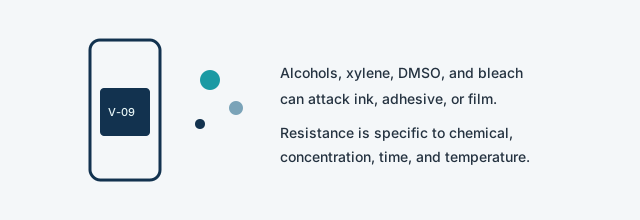
Laboratories use alcohols, ketones, aromatic solvents, dimethyl sulfoxide (DMSO), aldehydes, acids, bases, and disinfectants such as sodium hypochlorite solutions. Any of those can attack the image, the face stock, the adhesive, or all three. “Chemical-resistant” on a headline is incomplete until you name the chemical and the contact pattern: a quick wipe, a soak, a vapor, or a spill left overnight.
How chemicals destroy labels
Solvents can dissolve thermal-transfer wax ribbons, inkjet dyes, and some toners. They can swell adhesives so the label slides. They can craze or cloud certain films. Paper wicks the liquid and then tears. A construction that survives 70% isopropanol wipes may fail in xylene used in histology. Do not generalize from one solvent to “all chemicals.”
OSHA’s Hazard Communication Standard addresses how chemical hazards are communicated in U.S. workplaces. It does not rate stickers. It does remind you that secondary containers and process chemicals are part of a controlled system. Labels on reagent bottles may need durable hazard information in addition to a catalog number; that is a workplace-information problem as well as an adhesive problem.
Histology and solvent-heavy benches
Xylene, substitutes, alcohols, and stains challenge both slide labels and cassette marks. If a slide will be processed through solvents, the label has to live in the same solvents for the same time. See microscope slide labels and solvent exposure and print durability.
Disinfection and biosafety wipe-downs
CDC/NIH BMBL and the WHO laboratory biosafety manual discuss disinfection as part of safe work. Repeated bleach or alcohol contact is a chemical aging test you may not have planned when you chose a paper office label. If wipe-down is daily, include it in application trials: wipe as you would in the lab, then inspect edges and barcodes.
Testing without inventing a certificate
A practical check is: apply the candidate label to the real container, expose it to the real chemical for the real time, then attempt a scan and a peel. Record concentration, temperature, and whether the edge was laminated. That notebook record is more useful than a marketing adjective. Labeltaglab does not operate a test lab and does not issue certificates.
| Pattern | What to record |
|---|---|
| Wipe | Solvent, repetitions, pressure, cloth type |
| Splash / drip | Whether liquid sat on the edge |
| Soak | Time, temperature, agitation |
| Vapor | Closed container, duration |
Resin thermal-transfer ribbons on polyester films are a common pairing when solvents are expected, but pairing is not a guarantee. Ribbon, film, and printer darkness settings all change the result. See printing methods.
Concentration, time, and temperature are the real specification
A 70% alcohol wipe at room temperature is not the same as a 99% solvent soak at 37 °C. Tables that list only the chemical name hide those three variables. When you copy a vendor row into an SOP, copy the contact pattern too—or omit the row and write your own trial instead. Bleach solutions also lose available chlorine with time and with organic load; a wipe from a fresh bottle is not a wipe from a week-old spray.
Secondary chemical containers in a U.S. workplace may need durable hazard information under OSHA’s Hazard Communication Standard. That durability requirement is about remaining readable for the people who handle the bottle, not about a marketing adjective on a laboratory-specimen label. If the same construction is used for both jobs, test both jobs. If they differ, use two constructions and stop expecting one roll to be universal.
Open edges versus covered images
A laminate can protect an image while still leaving a thin adhesive edge for liquid to attack. Operators sometimes report “the print survived, the corner curled.” That is a coherent result. Closing the edge with overlap, a matching overlaminate, or a different wrap geometry may matter more than changing the ribbon. Record whether the failed sample had an open cut edge or a sealed overlap.
Questions this page answers
Will a laminate save any label from xylene?
A suitable over-laminate can protect some images, but adhesive at the edge can still be attacked, and some laminates themselves swell. Test the finished stack.
Are autoclave-resistant labels also solvent-resistant?
Heat, steam, and solvents are different stresses. A label can survive one and fail the other.
Why did the barcode survive but the adhesive fail?
The ribbon image and the adhesive are different chemistries. Report both outcomes; they point to different layers.
Can I rely on a manufacturer solvent table?
Use it as a starting filter, then repeat the contact that your SOP actually uses. Tables rarely match every concentration and wipe cloth.
Sources you can check
- OSHA Hazard Communication Standard
- CDC/NIH, Biosafety in Microbiological and Biomedical Laboratories, 6th ed.
- WHO Laboratory biosafety manual, 4th ed.
- ASTM D3330/D3330M, peel adhesion of pressure-sensitive tape
- ISO/IEC 15416, linear barcode print quality
External sites are cited for verification. Labeltaglab is not affiliated with those organizations. See the external links disclosure.