
Common labeling problems
Name the failure mode before you change the entire catalog. Edges, images, and scanners fail for different reasons.
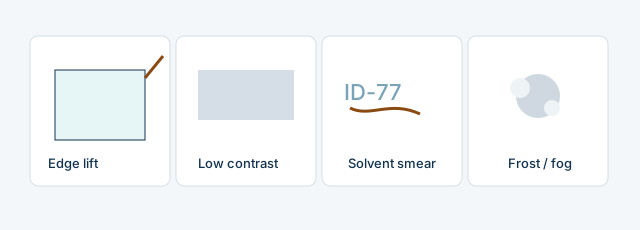
When a label “does not work,” name the failure. Edge lift, fall-off, smear, fade, unreadability, and cracking point to different layers. Treating all of them as an adhesive problem wastes time. This page is a field guide; deeper notes live in the Knowledge Center.
Edge lift and fall-off
Peel starts at an edge that never wetted, sat on frost, or was attacked by solvent. Short wrap, mold seams, and glove snags finish the job. See adhesive failure in laboratories and storage temperature and adhesion.
Smear and chemical attack
If text wipes off while the film stays put, the image chemistry lost. If the film slides, the adhesive lost. If the film wrinkles or clouds, the face stock may have swollen. See chemical-resistant labels.
Unreadability without peel
Frost, fog, low contrast films, and undersized barcodes fail scanners while the label is still attached. That is a success for adhesion and a failure for identification. See condensation and readability and barcode basics.
Darkening, fading, and heat
Direct-thermal images respond to heat. Autoclaves and sunny windowsills are not the same, but both can destroy contrast. Laser toner can crack if a film flexes after a brittle fuse. Record the print method in the failure note.
Wrong container, right label
A construction that holds on glass bottles can lift on low-energy polypropylene. A slide label can be perfect and still be the wrong size for a cryovial. Container mismatch is not a mysterious quality escape. See labels by container.
| Question | If yes, look at… |
|---|---|
| Was the surface wet, frosted, or oily? | Application and adhesive wet-out |
| Did a solvent or disinfectant touch the edge? | Chemical compatibility |
| Did the item go through steam? | Autoclave construction and print method |
| Does it scan at the bench but not in the freezer? | Contrast, frost, quiet zones |
| Did tube brand or diameter change? | Wrap length and surface energy |
Repository and biosafety documents (ISBER, ISO 20387, BMBL, WHO) assume identity remains attached to the material. A recurring failure mode is a quality-system issue, not only a purchasing issue.
Identity failures that are not peel
Two vials can wear intact labels and still be mixed up if accession numbers were duplicated, if a cap migrated, or if a handwritten 8 looks like a 0. Durability does not fix a weak numbering scheme. Unique IDs, a human-readable copy of the code, and a rule that the wall—not the cap—carries identity prevent a class of disasters that no adhesive can prevent.
Relabeling is a high-risk moment. People peel a failing mark and replace it from memory. Write the ID down or scan it into a system before the old label is gone. If residue blocks the new wrap, clean with a method that your chemical-compatibility notes already include—not with an unidentified solvent from under the sink.
When many labels fail together
A single lifted corner is often application. A whole week’s production failing is often a lot change, a printer setting, a new tube brand, or a new wipe chemical. Stop and compare lots before you rewrite the SOP. Media, ribbon, and tube SKUs belong in the batch record if identity is critical to the work.
Questions this page answers
Should I just press harder next time?
Pressure helps wet-out, but it will not fix frost, the wrong wrap length, or a solvent that dissolves the ribbon.
Why do labels fail weeks later, not on day one?
Creep, freeze–thaw, repeated wipes, and delayed solvent exposure. Time is a test condition.
Can I restick a lifted label?
Usually you trap dust and lose adhesive area. Replace it with a procedure that records the ID first.
Who should investigate recurring failures?
The people who apply labels, the people who run the process, and whoever controls media lots—together. It is rarely only ‘the sticker.’
Sources you can check
- ASTM D3330/D3330M, peel adhesion of pressure-sensitive tape
- ISO/IEC 15416, linear barcode print quality
- ISBER Best Practices for Repositories
- ISO 20387, Biotechnology — Biobanking
- CDC/NIH, Biosafety in Microbiological and Biomedical Laboratories, 6th ed.
- WHO Laboratory biosafety manual, 4th ed.
External sites are cited for verification. Labeltaglab is not affiliated with those organizations. See the external links disclosure.