
Choosing laboratory label materials
Work from the process and the container toward a construction. A catalog SKU is the last line, not the first.
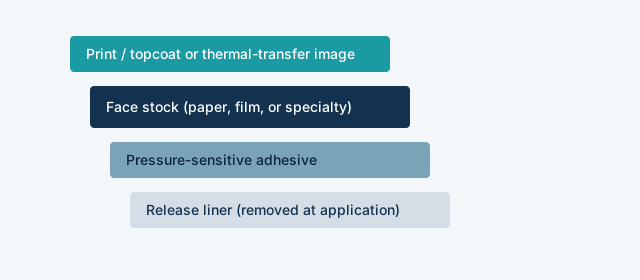
Choosing a laboratory label is easier if you refuse to start with a product name. Start with the process the container will see, then the container geometry, then the print method your printers can actually run, then the adhesive. That order prevents a common mistake: buying a film that looks “cryogenic” in a headline while your real problem is xylene on a slide, or buying a solvent-tough ribbon for a tube that only ever sees a −20 °C freezer.
Step 1 — List the environments in order
Write every step, not only the storage setpoint. Example: label at the bench, wipe with 70% alcohol, freeze at −80 °C, thaw, wipe again, maybe autoclave the empty tube later. The harshest step sets the construction. If LN2 immersion is on the list, cryogenic service dominates. If only a household-style freezer is on the list, do not import LN2 requirements that shrink your options for no reason. If steam is on the list, read autoclave-resistant labels before you pick paper.
Step 2 — Measure the container
Record diameter, straight-wall height with the cap on, and any writing patch. Note glass versus polypropylene. A construction that is excellent on a 50 mL conical tube can be unusable on a 0.5 mL cryovial. See labels by container.
Step 3 — Choose how the image will be made
If you only have a direct-thermal printer, you cannot magically obtain a resin image. If you have thermal transfer, budget for a ribbon that matches the film. If you have only a laser printer, you are in sheet-label territory with heat and possible adhesive ooze. Align hardware with printing methods before you fall in love with a roll that will not fit the printer.
Step 4 — Adhesive and application window
Ask whether labels will be applied to dry ambient containers or to cold, possibly frosted ones. That single operational fact eliminates many adhesives. ASTM D3330-type peel data, when a vendor shares comparable numbers, are still panel tests. They help you compare, not to skip a trial on your tubes.
Step 5 — Identification payload
Decide linear versus 2D, human-readable size, and whether RFID is an overlay. Space on a vial is finite. A 20-character caption in 4-point type is not a payload; it is decoration. See barcode basics.
What not to optimize first
Color, gloss, and catalog photography. Independent educational sites, including this one, should not treat a lifestyle image of a labeled rack as evidence. Manufacturer pages—including those from LabTAG—are useful as data-sheet hosts, not as proof that a SKU matches your SOP.
ISO 20387 and ISBER Best Practices ask repositories to keep identity with the specimen. They do not pick your face stock. Use them to justify why the decision matters, then use a trial to justify the construction. The companion article planning a fair label trial turns this sequence into a notebook page.
Write the decision down
A one-page record that lists environment, container measurements, printer model, ribbon, darkness, and pass/fail criteria will outlive a conversation in a corridor. Store it with the SOP. When a new tube brand arrives, you will know what to repeat. This is documentation, not bureaucracy, and it is how identity systems survive staff turnover.
If two groups in the same building need different constructions, allow two. A shared “house label” that fails in histology and in LN2 is not a savings. The comparison page and this sequence exist so those two groups can speak the same layer vocabulary even when they buy different media.
Questions this page answers
Should I pick the adhesive first because labels fall off?
Only if you already know the film and print survive. Otherwise you will restick a smear.
Can one SKU cover slides and cryovials?
Rarely. Geometry and solvent paths differ too much. Two constructions cost less than one mixed-up archive.
Where do cost and lead time enter?
After a construction has passed a small trial. Buying the cheapest roll first is how laboratories collect failed experiments.
Do I need a consultant to choose labels?
No. You need a written environment list, measurements, and a trial. Labeltaglab does not offer consulting.
Sources you can check
- ASTM D3330/D3330M, peel adhesion of pressure-sensitive tape
- ISBER Best Practices for Repositories
- ISO 20387, Biotechnology — Biobanking
- ISO/IEC 15416, linear barcode print quality
External sites are cited for verification. Labeltaglab is not affiliated with those organizations. See the external links disclosure.