
Solvent exposure and print durability
Name the liquid and the contact pattern. ‘Chemical-resistant print’ without those details is not a result.
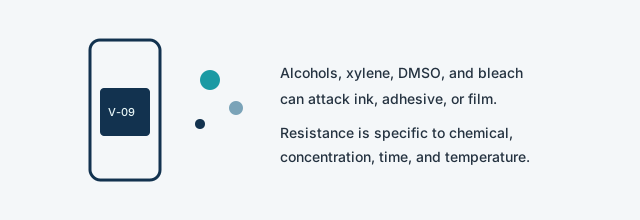
Print durability in solvent is independent of whether the film stays on the tube. Ribbons, toners, inkjet inks, and marker fluids have their own solubility. A fair trial names the liquid, the concentration, the contact pattern, and the endpoint (scan, smear, peel).
Wipes
70% isopropyl alcohol on a wipe is a common biosafety habit discussed in general form in BMBL and WHO biosafety materials. It is also a ribbon test. Count repetitions and pressure. One gentle wipe is not ten aggressive wipes. If wipe-down is daily, daily is the test.
Histology paths
Timed alcohol and xylene (or substitutes) are closer to a soak with agitation. Slide labels and cassette marks have to live in that path. A bottle-label success does not transfer. See microscope slide labels.
DMSO, phenol, and surprises
Research chemicals are not interchangeable with ethanol. DMSO in particular moves through some polymers. If a protocol uses a chemical, that chemical belongs in the trial even if a vendor table never listed it. OSHA hazard communication still expects durable workplace information on chemical containers; running ink fails that expectation.
Do not average vendor tables
A table that says “alcohol: pass” may mean a brief wipe on a laminated nameplate. Your edge may be open. Your temperature may be 4 °C. Your cloth may be abrasive. Copying a table into an SOP without a local trial is how laboratories invent false confidence. Labeltaglab will not invent replacement tables.
Cloths, sprays, and saturation
A barely damp wipe and a dripping spray deliver different solvent doses. Spunlace wipes can abrade matte topcoats that cotton does not. If your biosafety SOP specifies a saturated wipe and a contact time, that is the print test. Inventing a gentler wipe for the trial is how laboratories pass tests and fail Mondays.
Stain programs add colorants that can mask a smeared barcode until a later step. Inspect after the solvent steps that matter, not only after the pretty counterstain. Photographing a failure with a scale bar is more useful than describing it as “a bit smeary.”
Marker ink added after printing is a third chemistry. If people annotate printed labels, include those pens in the wipe test. A resin barcode that survives xylene is still a failure if the handwritten date beside it dissolves and operators then distrust the whole mark. Print the data you refuse to lose; write only what you can afford to lose.
Questions this page answers
If the barcode still scans after a wipe, did the print pass?
If your endpoint is scanning, yes for that wipe. Also inspect for thinning that will fail next week.
Can a laminate fix every ink?
It can protect some images and still leave an adhesive edge for the solvent to attack.
Are autoclave steam and xylene similar?
No. Steam is moist heat. Xylene is an organic solvent. Success in one is not success in the other.
Should markers be part of the print-durability trial?
If people write on labels, yes. Marker ink is another chemistry.
Sources you can check
- OSHA Hazard Communication Standard
- CDC/NIH, Biosafety in Microbiological and Biomedical Laboratories, 6th ed.
- WHO Laboratory biosafety manual, 4th ed.
- ISO/IEC 15416, linear barcode print quality
External sites are cited for verification. Labeltaglab is not affiliated with those organizations. See the external links disclosure.